Can a Surron Go 70 MPH? Stock vs Modified Top Speed
Table of Contents
- Can a Surron Go 70 MPH? The Straight Answer
- The Real Stock Surron Top Speed by Model
- How Speed Claims Get Measured and Verified
- What a Surron Speed Upgrade Actually Requires
- Surron Controller Upgrade: The Biggest Speed Lever
- Surron Battery Upgrade: Voltage, Amps, and Top Speed
- Range, Heat, and Reliability Trade-Offs at High Speed
- Safety and Legal Realities of a 70 MPH Surron
- Frequently Asked Questions
Last Updated: October 18, 2026
Can a Surron Go 70 MPH? The Straight Answer
Can a Surron go 70 mph? No stock Surron hits 70 mph. The fastest factory model, the Ultra Bee, tops out around 59-65 mph. Getting to 70 mph takes a modified setup with a controller and battery upgrade, and it comes with real trade-offs.

Here's the short version: a Surron can go 70 mph, but only after you change the power system. The stock bike has a speed limiter baked into its controller and a battery sized for trail riding, not highway pulls.
So what separates a 50 mph commuter from a 70 mph build?
Three things: voltage, current, and heat management. Miss any one and you either cap your speed or cook your components.
Below, we break down real stock numbers by model, explain how speed claims get measured, and walk through what a genuine speed upgrade requires. We'll also cover the range and reliability costs nobody mentions in the hype videos.
The Real Stock Surron Top Speed by Model
Stock top speed varies a lot across the Surron lineup, and the gap between the fastest factory bike and 70 mph is the whole story. The Light Bee X sits near 50 mph, the Light Bee 2 reaches about 56 mph, the Ultra Bee lands in the 59-65 mph range, and the Storm Bee, Surron's largest stock platform, is rated in the low-to-mid 60s. None of them touch 70 mph out of the box.

Here's how the 2026 models stack up on paper:
| Model | Peak Power | Battery | Stock Top Speed | Modified Top Speed (typical) | Price |
|---|---|---|---|---|---|
| Light Bee X | 10 kW | 72V / 35Ah | 50 mph | 55-65 mph with controller and battery upgrade | $3,899 |
| Light Bee 2 | 24 kW | 78.54V / 45Ah | 55.92 mph | 60-70 mph with matched controller, battery, and gearing | $5,499 |
| Ultra Bee | 24.5 kW | 74V / 60Ah | 59-65 mph | 65-75 mph with high-current controller and higher-voltage pack | $5,800 |
| Storm Bee | 22.5 kW | 90V / 48Ah | Low-to-mid 60s | 70+ mph with controller and pack changes | $9,999 |
The pattern is clear: more peak power and a bigger battery push the top speed higher, but no stock configuration crosses 70 mph. The Ultra Bee's 24.5 kW motor and 60Ah pack get it closest, and the Storm Bee's higher-voltage 90V architecture gives it the most headroom for a modified build, but both still fall short in factory form.
Light Bee X, Ultra Bee, and Storm Bee Compared
The Light Bee X is the entry point. It's light at roughly 130 lbs and rated for up to 50 mph. Great for trails, not a 70 mph machine. A modified Light Bee X can approach 65 mph with a controller and battery change, but the small frame and light chassis make sustained high speed a handful.
The Ultra Bee is the closest stock option and the most common starting point for a 70 mph build. It runs a 24.5 kW motor and a 74V / 60Ah battery, rated for 59-65 mph. Real-world speed depends on rider weight, terrain, and charge level.
The Storm Bee sits above the Ultra Bee in Surron's lineup with a 90V / 48Ah pack and a 22.5 kW motor. Even it doesn't guarantee 70 mph in stock form, but its higher voltage gives it the most ceiling for a modified build.
How Speed Claims Get Measured and Verified
Most 70 mph claims you see online come from a phone GPS app, a dashboard readout, or a downhill run with a tailwind. Those numbers are not reliable, and the reason is mechanical: a dashboard speedometer is calibrated to the stock wheel and gearing, so a gearing change or a different tire profile throws it off.
Here's how to actually verify a top-speed claim:
- Use a dedicated GPS unit, not a phone app, on a flat, windless stretch. Log the run so the data can be reviewed later.
- Note rider weight and tire pressure, since both change the result. A 150 lb rider and a 220 lb rider will not see the same number on the same bike.
- Run the test both directions and average the two runs to cancel out wind and grade.
- Log battery charge level, because voltage sag cuts top speed as the pack drains. A 70 mph run on a full pack may be a 62 mph run at 50% state of charge.
- Record ambient temperature and surface, since cold packs deliver less current and loose surfaces scrub speed.
A common mistake is trusting a single run. Speed claims are only useful when the method is repeatable. If a seller can't tell you how they measured 70 mph, which GPS, what charge level, what gearing, what rider weight, assume it's inflated.
The deeper issue is that top speed on an electric bike is a system output, not a single spec. Voltage sets the RPM ceiling, the controller's current limit sets how hard the motor can pull against wind and rolling resistance, and gearing converts motor RPM to wheel speed. Change any one and the dashboard number can drift from reality.
What a Surron Speed Upgrade Actually Requires
A real speed upgrade is a system change, not a single part swap. You need more voltage, more current, and components that can handle the heat. The controller and battery are the two biggest levers.
Here's the practical checklist we walk customers through:
- Confirm your target speed and budget
- Check whether your motor can handle the extra current
- Upgrade the controller to raise the current limit
- Match the battery voltage and amp-hour rating to the new controller
- Verify wiring, connectors, and fuses are rated for the higher load
- Test in a low-power mode first, then step up gradually
- Monitor motor and controller temperatures on early rides
Skip the wiring and fuse check and you risk a meltdown. Compatibility matters more than raw specs.
Surron Controller Upgrade: The Biggest Speed Lever
The controller is the single biggest speed lever on a Surron. It sets the current limit and enforces the speed limiter. Swap it for a higher-current unit and you unlock more top-end speed, provided the battery and motor can supply it.
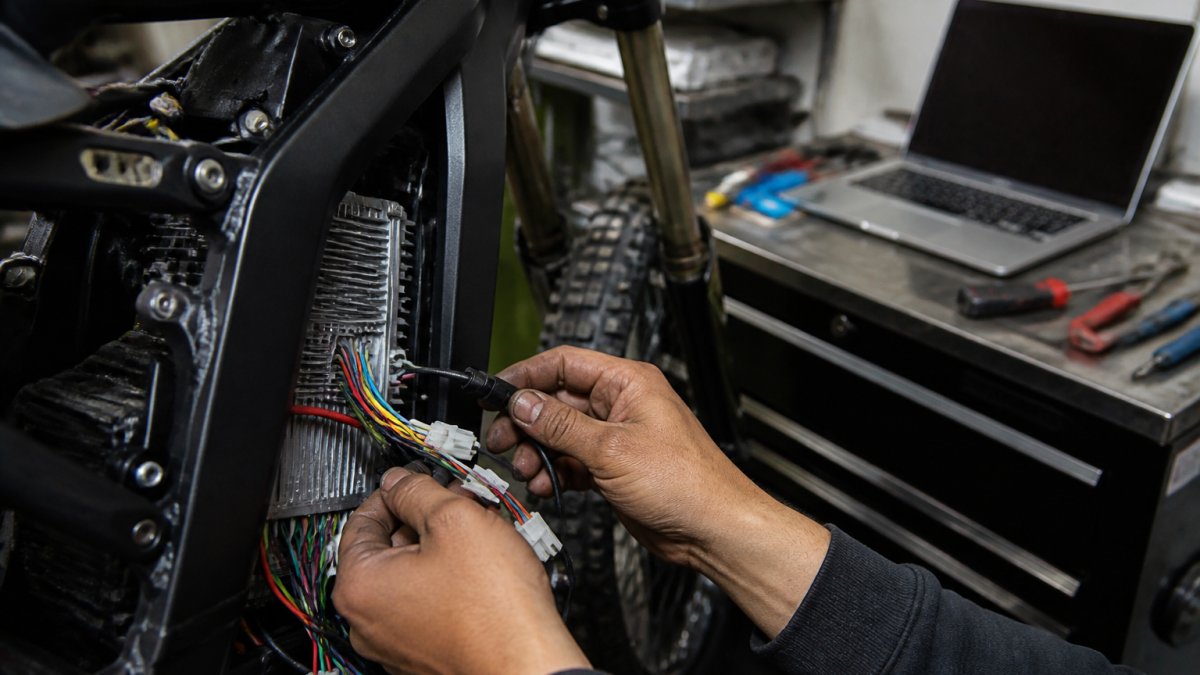
A controller upgrade changes how much power flows to the motor. More current means harder acceleration and a higher top speed, up to the motor's limit. But the stock battery may not deliver enough amps, so the controller and battery upgrade usually go together.
What most guides miss: tuning matters as much as the hardware. A well-tuned controller on a matched battery will outperform a bigger controller with sloppy settings every time.
Surron Battery Upgrade: Voltage, Amps, and Top Speed
Battery voltage sets the ceiling on motor RPM, and RPM translates to speed. A 72V pack has a lower speed ceiling than a higher-voltage pack. Amps determine how much current you can pull, which drives acceleration and hill-climbing.
So how do voltage and amps work together? Voltage is the top-speed ceiling. Amps are the push. You need both to reach 70 mph without bogging down.
A few rules we follow on battery upgrades:
- Match pack voltage to what your controller and motor can safely handle.
- Check the continuous amp rating, not just the peak.
- Confirm the pack's connectors and BMS are rated for the load.
- Expect less range as you push higher speeds.
The 2026 Ultra Bee's 74V / 60Ah pack shows how Surron sizes batteries for balance. A 70 mph build usually needs more voltage and current headroom than a stock pack provides.
Range, Heat, and Reliability Trade-Offs at High Speed
Speed costs range. Pushing a Surron to 70 mph drains the battery fast and heats the motor and controller. The stock Ultra Bee is rated for up to 71 miles in eco mode at a steady 31 mph. Run it near its top speed and that number drops sharply.
Heat is the hidden cost. Higher current means more heat in the motor, controller, and wiring. Without cooling and conservative tuning, you risk thermal cutouts or damaged components. Reliability suffers too, because every part runs closer to its limit.
A common mistake is chasing peak speed and ignoring how the bike behaves on ride two and ride three. A build that hits 70 mph once but overheats on the next ride isn't a real 70 mph bike.
Safety and Legal Realities of a 70 MPH Surron
A 70 mph Surron is a serious machine, and the rules matter. Many Surron models are sold as off-road bikes, not street-legal vehicles. Running 70 mph on public roads without the right registration and equipment can get you cited or worse.
Before you ride at speed, sort out these points:
- Check your local rules on registration, licensing, and where the bike can legally be ridden.
- Upgrade your gear to match the speed, including a proper helmet and body protection.
- Inspect brakes and tires rated for high-speed use.
- Keep speed-limiting modes available for low-power riding in tight areas.
The National Highway Traffic Safety Administration publishes guidance on vehicle safety standards worth reviewing if you plan to ride on or near public roads. Rules vary by state, so confirm what applies where you ride.
Safety isn't a footnote on a 70 mph build. It's the difference between a fun upgrade and a bad day.
Getting a Surron to 70 mph is doable, but it's a system build, not a bolt-on. You need a matched controller, battery, and wiring, plus honest testing and heat management. That's exactly the kind of work we do at Untamed Racing. Our family-run shop offers hands-on service for all e-moto brands, expert tuning, and access to premium parts, whether you bought your bike from us or not.
Frequently Asked Questions
Can a stock Surron reach 70 mph?
No. A stock 2026 Light Bee X tops out around 50 mph, the Light Bee 2 at about 55.92 mph, and the Ultra Bee at roughly 59-65 mph. None of the factory setups hit 70 mph out of the crate. Getting there means changing the power system, not just flipping a switch. A speed limiter or low-power mode can only reduce output, never add it, so 70 mph requires a Surron speed upgrade with real hardware behind it.
What is the top speed of a stock Surron?
It depends on the model. The Light Bee X is rated up to 50 mph from its 10 kW peak motor and 72V 35Ah battery. The Light Bee 2 reaches 55.92 mph with a 24 kW motor and 78.54V semi-solid-state pack. The Ultra Bee runs 59-65 mph on a 24.5 kW motor in Turbo mode. Rider weight, terrain, and state of charge all pull those numbers down in practice, so treat the stock Surron top speed as a best-case figure.
Does a larger battery increase Surron top speed?
A Surron battery upgrade can raise top speed, but only if it delivers more voltage and the controller and motor can use it. A higher-capacity pack with the same voltage mostly adds range. Jumping to a higher-voltage pack pushes the motor harder, which is where the extra mph comes from. That change usually needs a matching controller and careful thermal checks, since the stock motor and wiring have limits.
Is it safe to ride a modified Surron at 70 mph?
At 70 mph the stock brakes, tires, and suspension are working well past their design window, so a speed build should include upgraded brakes, tires rated for the speed, and suspension tuning. Rider weight and terrain matter more at that speed, and range drops fast as you hold it. Check local rules too: a Surron at 70 mph is not a street-legal bicycle in most places, and public land access can be restricted.